By Morgan Benitez
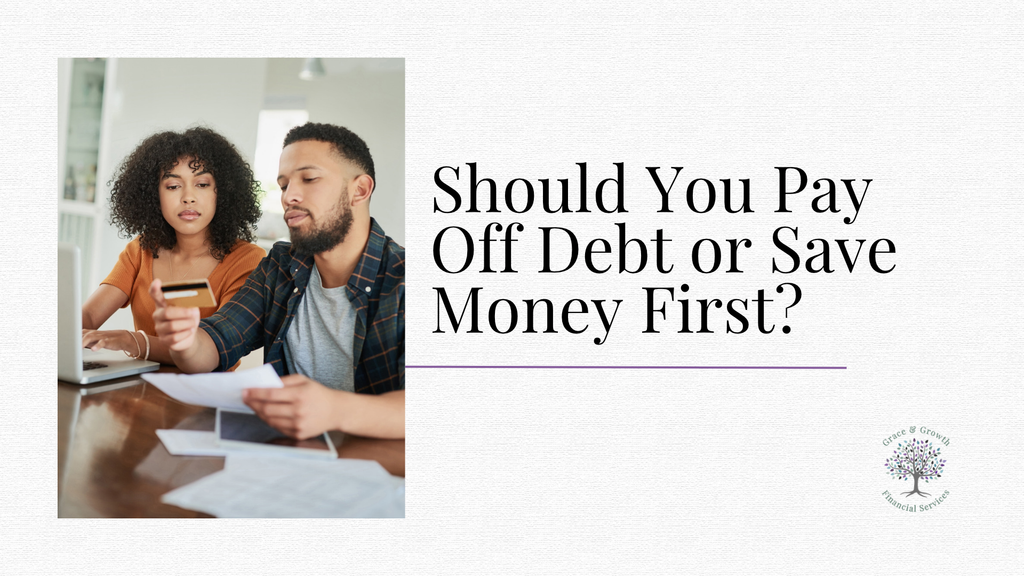
Picture this: You’ve got a little extra margin in your budget, and you want to be intentional and wise about what you do with that money. You may have cut out some things from your budget, gotten rid of a monthly payment, or worked some extra hours this month. You’re trying to be responsible, so what should you do first? Use the money to pay off debt, or save the money?
You believe that saving money and paying off debt are both important and worthy goals, but they may feel at times like they are competing – or maybe you’re unsure which one should be the priority right now. Naturally, you Google it: “pay off debt or save first?” However, you soon realize that the answers given seem to vary, depending on perspective, financial framework or philosophy, experience, or beliefs. There are lots of opinions, and of course (as a human), you’d like a simple, universal answer.
As a financial coach, I’m sorry to tell you that when asked “Should I put my money in savings or throw it at debt first?” my answer is (the dreaded answer) “it depends.” Personal finances can be complicated and unique (personal) to your own life, and I don’t believe there is always a one-size-fits-all answer. BUT – I’m not going to leave you there. I’m also here to tell you that there is an approach I generally recommend (with a few caveats) – it just requires knowing a bit more about your situation first. Before we dive into that, I’ll let you know where I’d start this conversation if I were coaching you.
If it wasn’t already clear, this article reflects my personal perspective as a financial coach (not a financial advisor) and is about personal finances. If you are looking for topics related to business finances, visit our website’s blog to explore some of our other articles.
Highlights
- Whether you should pay off debt or save first depends on your current financial situation, but having a clear order of priorities can help you decide what to do next.
- Before aggressively paying off debt, consider covering your essential expenses and required payments and establishing a small starter emergency fund.
- Sometimes significant life events or necessary upcoming expenses may mean temporarily adjusting your financial plan, and that’s okay.
Before You Choose Between Saving and Paying Off Debt
If I were your financial coach, I would want to start by ensuring you are in a stable and safe place with your finances. By this, I mean I’d begin by asking if your “Four Walls” are covered, if you’re current on your obligations, and if you are making at least the required/minimum payments on your debts. These things must take priority before we can address the “putting money toward savings versus debt first” question.
If you’re unsure what “Four Walls” means, this refers to the most basic living necessities (not including “discretionary” or “fun” spending):
- Food – Ensuring you and your family are fed (this doesn’t mean eating out, etc.).
- Utilities – The essentials for your home to be running and safe, like water, electricity, gas, trash, or other important things for living (this could include things like internet if you work from home or need it for school).
- Shelter – Your mortgage or rent payments.
- Transportation – Money for fuel, car payments, or public transportation fares to be able to access work, school, or other essential living tasks like getting to the grocery store.
Beyond the Four Walls, it’s also important to ensure you’re “current” – you are caught up on any other bills or required financial obligations and that you are making at least the minimum payments on your debts.
If these things are covered, we could move on to the conversation of where to put any extra money without worrying (at least as much) about having a safe place to live, food to eat, a way to get to your job, or overdue payments that need your attention.
Start With a Small Emergency Fund
With the essentials covered, I would next recommend starting with a small (starter) emergency fund. An emergency fund is easily accessible savings for (true) emergencies, and it acts as a buffer between you (and the rest of your finances) and the mishaps and misfortunes of life. Generally, I would recommend an emergency fund of $1,000 (though if you feel more comfortable with slightly more, say $2,000, that’s okay too. Just keep in mind that a larger starter emergency fund can take away funds from other priorities, like paying off debt sooner).
If you have debts that you are working to pay off, a small emergency fund can help take care of “little” things (like a flat tire, unexpected doctor’s visit, or emergency plumber) without setting back your debt payoff progress. It can also keep those smaller emergencies from becoming new debt when you feel that you need to put them on a credit card, etc. – which you’re already trying to pay down! I believe this starter emergency fund also gives your mind and body a little more peace knowing that you’ve got this buffer.
Further down the road of your financial journey, I’d recommend a larger emergency fund of 3-6 months’ worth of your essential living expenses, but generally I would wait until you’ve paid off your non-mortgage debt first. If you have a $1,000 emergency fund set aside, you’re ahead of many Americans. Two separate 2026 surveys found similar results: 43% of Americans surveyed by U.S. News & World Report couldn’t cover a $1,000 emergency with savings, while Bankrate found that only 47% had sufficient funds available to cover one.
Next, Focus on Paying Off Debt
Once those foundations are in place, I’d (usually) recommend making your next priority paying off non-mortgage debts. There are lots of different methods (and opinions!) about how to do this. In my financial coaching, I recommend (and personally use) the Debt Snowball Method of paying off debts. While other methods may save more in interest, I like the Debt Snowball because paying off smaller balances quickly can provide motivation and momentum to keep going.
In the Debt Snowball Method, you start by listing all of your debts in order from smallest balance to the largest. You continue making minimum payments on all your debts except the smallest debt; with your smallest debt, your goal is to pay more than the minimum payment (as much extra money as you can) in order to make quicker progress and pay off this debt as fast as you can.
Once you’ve paid off that smallest debt, you take the money you were putting toward it and roll it (like a snowball getting bigger) into the next smallest debt.
You don’t need to include your home’s mortgage payments (if you have them) in this step; once you’ve paid off all your debts other than the house (generally people’s largest debt), I’d next recommend taking that starter emergency fund and working to increase your savings to a “fully funded” emergency fund (that 3-6 months of necessary living expenses I mentioned earlier). Then you can focus on making extra payments on the house.
But Sometimes… “Life Happens”
As with many “rules” in life, there are exceptions, and sometimes “life happens,” and your plan needs to adjust for one reason or another. There may be times during these first few steps when you become aware of a significant, necessary expense or major life event coming up. Things like:
- Pregnancy/a new baby
- An upcoming surgery or medical procedure
- An upcoming wedding (maybe your wedding, maybe your kid’s)
- Another significant life change, like a potential job loss or period of uncertain employment
This might call for temporarily pausing the extra money you’re putting toward debt (above your required payments) in order to save “aggressively” for the upcoming life event (hopefully, so you don’t go into more debt). I’ve heard this called going into “Storm Mode” (or “Stork Mode” for an upcoming baby) in the Ramsey community.
Ideally, this will be a temporary pause; once the event passes and the situation is stable, you can go back to putting that extra margin toward that smallest debt and working on your Debt Snowball, or toward your fully funded emergency fund (whichever step in your personal financial plan you were on before “pausing”).
And this might go without saying, but you’ll notice that I didn’t list a vacation or a new toy that you really want on the list of examples above. In my opinion, building your emergency fund savings or paying off debt should generally take priority over things like that – but what falls into that category of a life “storm” or reason to “pause” can be personal, and it’s up to you to ultimately decide how much you value an emergency fund or paying off debt over those things.
So, Should You Pay Off Debt or Save?
I apologize for being so long-winded with my answer to the initial question, but just like my answer, life is often more complex than we’d like it to be. Because of this, when it comes to personal finances, there may be general rules or advice, but there’s less often a black-and-white “everyone should do X” answer that is always true.
With that disclaimer stated once again and kept in mind, I feel comfortable saying that the progression that I believe to be generally most helpful is:
- Cover your “Four Walls” and required payments,
- Establish a small, starter emergency fund,
- Focus on paying off your non-mortgage debts, starting with the debt with the smallest balance and working your way toward the largest,
- (If needed, pause to temporarily adjust the plan and enter “Storm Mode” to save for a significant necessary expense),
- Once those debts are paid off (other than your home mortgage), move on to saving a fully funded emergency fund that can cover 3-6 months of your household’s essential expenses.
You Don’t Have to Figure it Out Alone
There is a progression or order I generally recommend for personal finances. A starter emergency fund gives you a buffer against life’s smaller emergencies, while the Debt Snowball Method can provide motivation as you begin paying off the smaller debts first. But sometimes life gives us good reasons to adjust the plan. Maybe your priorities change, or you simply need to temporarily save for something important or essential to you.
If you’re feeling overwhelmed trying to make a game plan for your finances, or not sure where to start when you feel like there are multiple competing expenses or priorities, it could be helpful to talk it through with someone you trust. This could be a friend, mentor, or financial professional such as a financial coach. As with other areas of life, sometimes it’s helpful to have the objective perspective of someone outside of the situation.
A financial coach can combine expertise and care to help you create a plan for your financial journey in a way that is compassionate and non-judgmental. I offer free, one-hour consultations to help you figure out if financial coaching is a good fit for you right now. I’d love to help you find some more peace and clarity in your life. If that’s something that would benefit you, please visit my Calendly page to book a time to chat.
Resources
- Bennett, Karen. (2026). Bankrate’s 2026 Annual Emergency Savings Report. Bankrate.
- Garrison, Greg. (2026). 2026 Financial Wellness Survey. U.S. News & World Report.
- Kamel, George. (2026). How the Debt Snowball Method Works. Ramsey Solutions.
- Ramsey Solutions. (2025). When to Pause Your Debt Snowball.
